How to Sell VPN: A Comprehensive Guide For VPN Entrepreneurs
Learn how to sell VPN successfully: market research, business models, sales funnels, pricing, and marketing strategies for VPN entrepreneurs.
Khan Muhammad Al Amin · September 20, 2026 · 23 min read
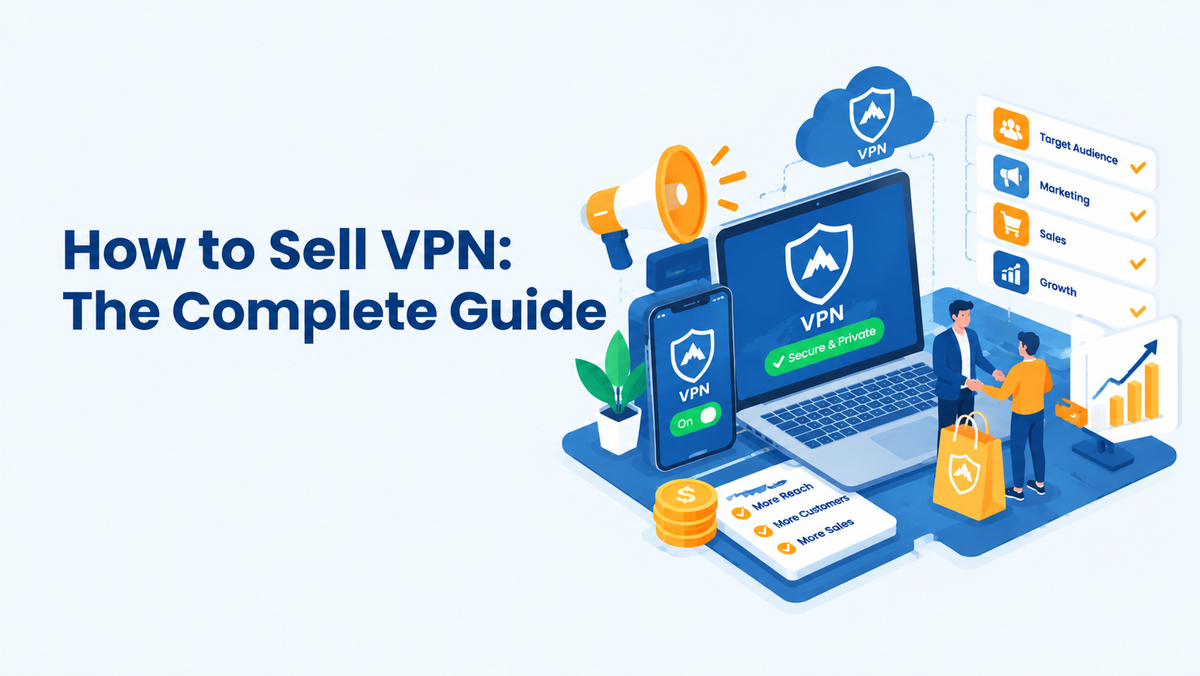
The VPN industry looks deceptively simple from the outside: buy a white-label solution, slap on a logo, and start collecting subscriptions. In reality, the market is one of the most saturated and technically demanding categories in consumer software. Hundreds of VPN brands compete for the same keywords, the same app store real estate, and the same privacy-conscious buyers — and most of them fail within the first eighteen months because they treat VPN selling as a marketing problem instead of a product-plus-trust problem.
Selling a VPN successfully means understanding encryption protocols well enough to explain them credibly, understanding acquisition economics well enough to survive the first two years of negative unit economics, and understanding trust-building well enough to convince skeptical users to hand over their entire internet traffic to your servers. This guide walks through every stage of that journey — from market research to infrastructure decisions to the exact sales funnels and marketing channels that work in 2026 — so you can build a VPN business that survives past year one.
Understand the VPN Landscape
Before writing a single line of marketing copy, you need to understand what you're actually selling and who else is selling it.
The global VPN market is projected to grow from roughly $50-60 billion to well over $150 billion by the early 2030s, driven by rising surveillance concerns, geo-restricted streaming demand, remote work security requirements, and expanding internet censorship in various regions. But growth doesn't mean easy entry — it means intensifying competition. A handful of well-funded players (Nord Security, Kape Technologies which owns ExpressVPN and CyberGhost, Surfshark, Proton) control a large share of paid subscriptions and dominate SEO rankings for every commercially valuable keyword.
What this means practically:
- You cannot out-SEO the giants on generic terms. "Best VPN" and "VPN for streaming" are effectively closed doors for a new entrant without a seven-figure content and backlink budget.
- Protocol and infrastructure differentiation is real but narrow. Most competitors run WireGuard or a proprietary WireGuard fork (NordLynx, Lightway) alongside OpenVPN and IKEv2. Technical superiority alone rarely wins customers anymore — it has to be paired with trust signals and positioning.
- Trust is the actual product. A VPN's core promise — "we won't look at your traffic" — is unverifiable by the end user. This is why audited no-logs policies, jurisdiction, RAM-only servers, and transparency reports have become the real competitive battlefield, not raw speed benchmarks.
- Regulatory pressure is rising. VPN bans and restrictions exist or are being debated in multiple countries, and platform policies (Apple App Store, Google Play) increasingly scrutinize VPN apps for permissions and data handling. Understanding jurisdictional risk (e.g., Five/Nine/Fourteen Eyes alliances) is now a baseline requirement, not a nice-to-have.
Entering this landscape requires a narrow, defensible niche rather than a "VPN for everyone" positioning.
Go for a Comprehensive Market Research
Generic competitor screenshots and a SWOT template are not market research — they're a starting checklist. Real research for a VPN business needs to answer three questions with data, not assumptions.
What jobs are people hiring a VPN to do?
Segment demand by use case, not demographic. The major use-case clusters are: streaming/geo-unblocking, P2P/torrenting, public Wi-Fi security, censorship circumvention, remote work/business access, gaming (ping reduction, DDoS protection), and privacy-from-ISP/advertisers. Each cluster has different technical requirements (server locations, protocol choice, speed vs. obfuscation trade-offs) and different willingness to pay.
Where is demand underserved?
Use tools like Ahrefs, Semrush, or Google Keyword Planner to map search volume against existing content quality — not just against competitor count. Look specifically for:
- Country- or language-specific gaps (e.g., VPN content in underserved languages for high-growth markets like Southeast Asia, Latin America, or Africa)
- Emerging device/platform gaps (routers, smart TVs, Linux, gaming consoles)
- Regulatory-driven demand spikes (a country tightening internet restrictions creates a short-term but real search surge)
What will people actually pay, and why do they churn?
Pull pricing pages of 15-20 competitors across tiers (budget, mid-market, premium) and track how pricing has moved over 12-24 months using the Wayback Machine. Read app store reviews (both 1-star and 5-star) obsessively — this is free, unfiltered qualitative research on what breaks trust (kill switch failures, slow speeds after "unlimited" claims, billing disputes) and what earns loyalty (customer support responsiveness, transparent no-logs audits).
Find Your Target Market
"Target market" here means the geographic and demand context you'll operate in — distinct from audience, which is about the individual buyer persona (covered next).
Practical ways to define your target market:
- By region of sale vs. region of use. Many successful VPN brands sell primarily to buyers in North America, Western Europe, or Australia (high card-payment trust, high willingness to pay) while operating exit nodes optimized for streaming or censorship-heavy regions elsewhere.
- By regulatory environment. Selling into markets with VPN restrictions (parts of the Middle East, China, Russia) requires obfuscation technology (stealth/shadowsocks-style protocols) and a different distribution strategy (since app stores may delist you) — this is a fundamentally different business than selling into the US streaming market.
- By vertical. B2B/business VPN (site-to-site, remote access for SMEs) is a separate target market from B2C consumer VPN, with different sales cycles (weeks to months vs. minutes), different pricing (per-seat vs. per-device), and different acquisition channels (outbound sales, IT reseller partnerships vs. app store optimization and influencer marketing).
Pick one primary market to dominate before expanding. Spreading thin across every geography and vertical is the single most common early-stage mistake.
Choose Your Target Audience
Once the market is defined, build 2-3 concrete buyer personas with enough specificity to write marketing copy directly to them. For each persona, define:
- Primary trigger event — what made them search for a VPN today? (Travel booking, a news story about data breaches, a streaming show unavailable in their country, starting a new remote job.)
- Technical literacy — do they know what a protocol is, or do they just want "the internet to work but private"? This determines whether your landing pages lead with jargon (AES-256, WireGuard, perfect forward secrecy) or benefits (watch anything, browse safely, no one's watching).
- Price sensitivity and payment behavior — students and price-shoppers respond to long-term discounted plans (2-3 year commitments at steep markdowns); business users respond to monthly flexibility and invoicing.
- Platform mix — a persona that's 80% mobile-first needs a business model and app experience radically different from a desktop power-user persona that wants router-level configuration and multi-hop connections.
H3 example personas
- "Streaming Sam" — wants Netflix libraries and sports streaming unblocked, low technical literacy, price-sensitive, mobile + smart TV.
- "Privacy Priya" — journalist or activist-adjacent, highly technical, prioritizes audited no-logs and jurisdiction over price, will pay premium for verified trust signals.
- "Business Ben" — IT manager at a 20-50 person company, needs centralized billing, device management, and SLA guarantees, buys annually via invoice.
Analyze Your Competitors
Competitive analysis for a VPN business needs to go deeper than feature-comparison tables.
Technical benchmarking
Actually test competitor apps: measure connection speed drop-off across server locations, time-to-connect, kill switch reliability (does it actually block traffic on disconnect?), DNS leak behavior, and split-tunneling accuracy. Document this — it becomes both a strategic input and future content (comparison articles, benchmark reports) that doubles as SEO and trust-building material.
Trust and transparency audit
Check whether competitors have published third-party security audits (Cure53, Deloitte, KPMG are common auditors in this space), whether they publish transparency/warrant canary reports, what jurisdiction they're incorporated in, and whether their no-logs claims have ever been tested in court or through server seizure incidents. Gaps here — a competitor with an unaudited "no-logs" claim — are exploitable in your own positioning.
Business model and monetization audit
Identify how competitors actually make money beyond subscriptions: affiliate commission rates (VPN affiliate programs often pay 30-100% of first payment, among the highest in SaaS), bundling deals (VPN + antivirus + password manager suites), reseller/white-label programs, and enterprise upsells. This tells you where the real margin is in this industry, not just the sticker price.
Positioning and messaging audit
Map each major competitor on two axes: price and trust-emphasis vs. speed/streaming-emphasis. Most competitors cluster in 2-3 zones. The open positioning space is usually a specific combination no one owns cleanly — e.g., "affordable + audited no-logs" or "business-grade security at consumer pricing."
Prepare Your Unique Selling Point
A defensible USP for a VPN brand needs to be something a competitor cannot copy overnight. Generic USPs like "military-grade encryption" or "blazing fast speeds" are meaningless — every VPN uses AES-256 and every VPN claims to be fast.
Strong, defensible USP categories:
- Jurisdiction and legal structure — incorporating in a privacy-friendly jurisdiction (Switzerland, Panama, British Virgin Islands) outside surveillance-sharing alliances, and making this a headline claim.
- Verified infrastructure — RAM-only (diskless) servers that wipe on reboot, independently audited no-logs policy, open-source apps with public code repositories for community verification.
- Underserved niche ownership — being the definitive VPN for a specific use case (gaming latency, a specific censorship-heavy region, a specific professional vertical like journalists or healthcare remote workers) rather than a generalist.
- Transparent, simple pricing — the VPN industry is notorious for aggressive discount psychology (fake "70% off" pricing permanently displayed). A genuinely transparent, stable pricing model is now a differentiator precisely because it's rare.
- Support quality as a feature — live chat response time under 2 minutes, technical support that can actually debug a firewall/router issue, not just a scripted chatbot.
Your USP should be provable, not just claimed — back it with an audit, a public policy document, or a demonstrable metric.
Choose Your Business Model
This is the single most consequential decision in the entire process, because it determines your capital requirements, technical team size, margins, and how fast you can launch.
Owned Infrastructure Model
You build and operate your own VPN server network, client apps, and backend from scratch.
- What it requires: A team capable of building protocol implementations (or integrating WireGuard/OpenVPN libraries), server provisioning and management across multiple countries (bare metal or cloud, ideally a mix — many premium VPNs avoid virtual private servers on cloud providers like AWS for jurisdiction and trust reasons), a billing and subscription system, and native apps for iOS, Android, Windows, macOS, and often Linux and routers.
- Cost profile: High upfront (six figures at minimum for a credible multi-country launch with real engineering), but the highest long-term margin and the only path to a genuinely defensible, sellable business asset.
- Best for: Founders with technical co-founders or in-house engineering, and a budget/runway of 18+ months before profitability, who want full control over trust claims (because they control the actual infrastructure).
White-Label VPN Model
You license an existing VPN infrastructure and app codebase from a white-label provider, then rebrand it — your logo, your pricing, your domain, their backend.
- What it requires: A white-label VPN provider contract (many exist commercially), your own branding, marketing, and customer support layer.
- Cost profile: Moderate upfront (often a setup fee plus a per-user or revenue-share cost), much faster time-to-market (weeks instead of a year-plus), lower margin than owned infrastructure since you're paying the underlying provider.
- Best for: Entrepreneurs with strong marketing/distribution skills but limited engineering resources, who want to test market fit before committing to building infrastructure. This is the most common entry point for new VPN entrepreneurs.
Reseller Model
You sell an existing, fully-branded VPN product under an affiliate or reseller agreement — you don't get your own branded app; you earn commission or margin on sales you drive.
- What it requires: Almost no technical investment — a marketing funnel, content, or sales relationships.
- Cost profile: Lowest barrier to entry, but lowest ceiling — you don't own the customer relationship, the brand equity, or the ability to raise prices/change terms.
- Best for: Testing the VPN niche with near-zero capital, content creators/affiliates who want to monetize an existing audience, or as a stepping stone toward a white-label or owned model once you understand the funnel economics.
Affiliate-First / Marketing Shell Model
A variant of reselling where you build a strong content/SEO brand (comparison sites, "best VPN for X" content) and monetize purely through affiliate commissions across multiple VPN providers rather than one.
- Best for: Content-first founders (SEO specialists, YouTubers, review site operators) who want diversified revenue without any product or support obligations.
How to choose based on budget and goals
Budget & Goal
Recommended Model
Under $10K, testing the niche, content-driven
Affiliate-first or reseller
$10K-$100K, want a real brand, fast launch, moderate risk tolerance
White-label
$100K+, technical co-founder available, want a sellable long-term asset and full trust control
Owned infrastructure
B2B focus, enterprise sales motion
Owned infrastructure or a business-focused white-label provider with SSO/team management features
A common and sound path: launch white-label to validate demand and funnel economics within 3-6 months, then reinvest profits into owned infrastructure once you have proven CAC-to-LTV ratios and a real user base to migrate.
Work On Sales Funnel
VPN buying behavior varies enormously by trigger, so a single funnel design rarely captures the whole market. Build (or adapt) at least two of the following.
The Free Trial / Freemium Funnel
Awareness (blog/SEO/social) → free trial or free-tier signup (no card required, ideally) → in-app upgrade prompts tied to usage limits (data cap, server limit, speed cap) → paid conversion email/push sequence → long-term retention via annual renewal discount. This funnel works best for low-technical-literacy, high-volume audiences (Streaming Sam persona) — the friction of "free" gets volume in, and habit plus feature-gating converts a percentage.
The Discount-Anchored Direct Response Funnel
Paid ad or influencer link → landing page with an anchored "was $X, now $Y" long-term plan (1-3 years) → checkout with upsells (dedicated IP, additional devices, password manager bundle) → immediate onboarding email sequence to reduce early churn (the highest-risk churn window is the first 7 days). This is the dominant funnel in the consumer VPN industry because most competitors run aggressive discount psychology — you need to match this pattern structurally even while differentiating on your USP.
The Trust-Led Content Funnel (best differentiator for a new brand)
In-depth comparison/audit content and transparency reports (SEO + backlinks from security publications) → email newsletter capturing top-of-funnel interest before any purchase intent → nurture sequence building trust (audit results, jurisdiction explainer, founder story) → conversion via a mid-tier plan (not the cheapest, not the most expensive) with a money-back guarantee as the final risk-reversal. This funnel converts slower but produces dramatically lower churn and higher LTV, because the buyer chose you on trust rather than price alone — making it ideal for the Privacy Priya persona and for a new brand that cannot win on price against incumbents.
The B2B/Sales-Assisted Funnel
Inbound lead (content, reseller partner referral, or outbound prospecting) → demo/consultation call → pilot with a small number of seats → contract negotiation and procurement (often involving security questionnaires and compliance documentation) → account management and renewal/expansion. This funnel is slow (weeks to months) but has far higher per-account value and much lower churn than consumer funnels.
Match funnel to persona: don't force Business Ben through a discount pop-up funnel, and don't force Streaming Sam through a demo-call funnel.
Work on Pricing & Offers
VPN pricing is a psychology-heavy discipline because the product itself is largely undifferentiated to the end user at the point of purchase — pricing structure often does more conversion work than product features.
Structural pricing decisions
- Long-term plan anchoring. The industry norm is monthly price 3-5x higher than the effective monthly rate of a 2-3 year plan, displayed with the original price crossed out. This drives strong upfront cash collection and reduces short-term churn, but it creates a long-term trust risk if the discount looks artificial — pair it with genuine value adds (extra devices, bundled tools) rather than pure price theater if your USP is trust-based.
- Per-device vs. per-account pricing. Family/household-friendly pricing (5-10 simultaneous devices per subscription) is now a baseline expectation, not a premium feature.
- Tiered feature gating. Common tiers: Basic (core VPN, limited servers/speed), Standard (full server list, standard speed), Premium (dedicated IP, ad/tracker blocking, multi-hop routing, business-grade features). Don't gate the kill switch or core encryption behind a paywall — security fundamentals should be universal; gate convenience and advanced features instead.
- Money-back guarantees. 30-45 day guarantees are near-universal in this category and function as a conversion-rate-optimization tool more than an actual expected refund cost (refund rates are typically low if onboarding is good).
Offer design
- Bundle offers (VPN + password manager + antivirus/data-breach monitoring) increase average order value and reduce the perceived "just a VPN" commoditization.
- Seasonal and event-based offers (Black Friday, Safer Internet Day, back-to-school) create urgency spikes that are worth planning a full content and ad calendar around in advance.
- Reactivation/win-back offers for churned users, sent 30-60-90 days post-cancellation, typically recover a meaningful share of lapsed subscribers at a fraction of new-customer acquisition cost.
Prepare Marketing Plan
A VPN marketing plan needs to run across owned, earned, and paid channels simultaneously, because no single channel is defensible alone in this category.
SEO
Long-tail, use-case-specific content ("VPN for [specific streaming service] in [specific country]," "how to VPN for [specific gaming title]," "is [specific app] safe on public Wi-Fi") outperforms head-term content for a new brand. Build a genuine comparison/review content hub, publish real benchmark data (speed tests, leak tests) rather than generic claims, and pursue backlinks from security and tech journalism through original research (e.g., an annual "state of internet censorship" or "state of VPN speeds" report) rather than paid link schemes, which carry real penalty risk.
GEO (Generative Engine Optimization)
As AI answer engines (ChatGPT, Google AI Overviews, Perplexity) increasingly mediate "best VPN for X" queries, optimizing for citation within AI-generated answers is now distinct from traditional SEO. Practical GEO tactics: structure content with clear, extractable factual claims and data points (AI summarizers favor specific, quotable facts over vague marketing copy); maintain an up-to-date, well-structured comparison/spec page that's easy for a model to parse; publish original data (speed benchmarks, audit results) since AI engines preferentially cite primary sources over aggregator content; and ensure your brand has consistent, verifiable facts across Wikipedia-adjacent, Trustpilot, Reddit, and G2-style third-party platforms, since generative engines weight cross-source consistency heavily.
Social Media
Short-form video (TikTok, Reels, YouTube Shorts) demonstrating concrete use cases — unblocking a specific show, showing a public Wi-Fi risk demo, a "day in the life" of a remote worker using a VPN — outperforms generic brand content. Reddit (particularly privacy and tech subreddits) is a uniquely important channel for this category specifically because the audience is trust-sensitive and actively researches before buying; transparent, non-salesy participation (answering technical questions, being honest about limitations) builds outsized credibility relative to effort.
Paid Ads
Search ads on branded competitor terms and high-intent long-tail terms tend to have better ROAS than broad awareness campaigns for a new entrant. Video ad creative that addresses a specific fear or use case (data breach news hooks, streaming unavailability) converts better than generic "stay private" messaging. Budget for a longer attribution window than typical e-commerce — VPN purchase decisions often take multiple touchpoints across 7-14 days.
Influencer Marketing
VPN is one of the most heavily saturated influencer-sponsorship categories (especially YouTube tech and gaming channels), which means audiences are increasingly ad-blind to generic sponsor-read scripts. Differentiate by choosing micro-influencers in tightly relevant niches (a specific game, a specific country's expat community, a specific professional field) over broad-reach mega-influencers, and insist on usage-based, authentic demonstrations over scripted claims — this both converts better and reduces regulatory/trust risk from exaggerated claims.
Affiliate Marketing
Build a structured affiliate program (tiered commissions rewarding volume, cookie windows of 30-90 days, real-time dashboards) and actively recruit review-site and comparison-content affiliates rather than waiting for inbound applications — this is a full business-development function, not a passive program.
Reseller Programs
Offer a reseller or partner tier for agencies, IT consultancies, or regional distributors (especially relevant for B2B or for expansion into markets where local trust and payment infrastructure matter, such as offering local payment methods and local-language support through a regional partner).
Prepare a Solid Brand Guideline
Because the core product claim (privacy) is invisible and unverifiable, brand presentation carries disproportionate trust weight in this category. A brand guideline for a VPN company should explicitly define:
- Visual identity that signals security without cliché. Avoid the over-used shield/padlock/hoodie-hacker visual language that saturates the category — it now reads as generic rather than trustworthy. Distinctive, clean design signals more competence than stock cybersecurity imagery.
- Tone of voice rules for technical honesty. Define explicitly how the brand talks about limitations (no VPN provides "100% anonymity," and claiming so is both misleading and a regulatory risk in several jurisdictions) versus genuine strengths — a documented, honest tone of voice guide protects the brand from overclaiming under marketing pressure.
- Legal and compliance language templates for privacy policy, no-logs claims, and marketing claims, reviewed by counsel familiar with FTC/consumer protection guidance on privacy and security marketing claims (this space has seen real regulatory enforcement action against overstated privacy claims).
- Consistent presentation of trust signals — where and how audit badges, jurisdiction statements, and transparency reports appear across the app, website, and marketing materials, so they're not one-off claims but a systematic brand pillar.
Choose the Right App Development Partner
If you're not building fully in-house, vetting a development partner (for a white-label deployment or custom app build) requires VPN-specific due diligence beyond typical app development vetting:
- Protocol expertise, not just app development. Ask specifically about their experience implementing or integrating WireGuard, OpenVPN, and IKEv2/IPsec, and how they handle protocol fallback and obfuscation for censorship-resistant connections.
- Security architecture transparency. They should be able to explain, in specific technical terms, how the kill switch is implemented at the OS level (not just "we have a kill switch"), how DNS leak protection works, and how split tunneling is handled per platform (iOS's stricter VPN APIs behave differently from Android's).
- Track record with app store compliance. VPN apps face specific, evolving review scrutiny from Apple and Google around permissions, data collection disclosures, and (in some cases) region-specific restrictions. A partner without direct VPN app store approval experience is a real risk to your launch timeline.
- Server-side and scaling experience, not just client app development — server provisioning automation, load balancing across regions, and DDoS mitigation for the server fleet itself.
- Post-launch maintenance terms, since VPN apps require frequent updates to keep pace with OS-level networking API changes (both Apple and Google have periodically changed VPN-relevant APIs in ways that break non-maintained apps).
Make a Strong Support Team
Support is a core trust and retention lever in this category, not a cost center to minimize.
- Staff for technical depth, not just scripted answers. Common VPN support issues (connection drops on specific ISPs, router configuration, corporate firewall conflicts, streaming service detection blocks) require genuine troubleshooting ability, not a canned script.
- Offer true 24/7 live chat where possible — response speed is one of the most consistently cited factors in VPN reviews and a major churn-prevention lever in the critical first-week window.
- Build a public, searchable knowledge base covering platform-specific setup, troubleshooting, and — importantly — honest limitation disclosures (e.g., which streaming services actively block VPNs and what to do about it). This doubles as SEO content and reduces support ticket volume simultaneously.
- Track support-driven churn signals. Tag tickets by issue type and correlate against cancellation data — this becomes one of your most valuable product-improvement inputs, often more actionable than general user surveys.
Keep Your App Updated Based on Feedback
VPN apps operate on infrastructure and OS layers that change more frequently than typical consumer apps.
- Establish a structured feedback pipeline connecting app store reviews, support tickets, and in-app feedback prompts to a prioritized engineering backlog — most VPN brands lose this signal because it's scattered across too many disconnected tools.
- Prioritize reliability fixes over feature additions in early releases — connection stability and kill-switch reliability issues cause more churn and worse reviews than any missing feature.
- Maintain a public changelog — transparency about what's fixed and why builds trust incrementally, especially for the technically literate segment of your audience who actually reads release notes.
- Monitor OS-level changes proactively (Apple/Google developer previews and beta OS releases) so protocol or permission changes don't break your app in production after a public OS release.
Leverage User Reviews to Gain Trust
Reviews function as a trust proxy specifically because the actual privacy claim can't be personally verified by a prospective buyer.
- Actively solicit reviews at the right moment — after a successful use case completion (first successful stream unblock, first week of stable connection), not immediately post-purchase.
- Respond publicly to negative reviews with specifics, not generic apology templates — this visibly demonstrates the technical competence and honesty that the category's trust deficit demands.
- Surface third-party validation prominently, not just star ratings: link directly to published security audit reports, cite independent speed test results from recognized testing outlets, and reference any court cases or server seizure incidents where a genuine no-logs policy was tested and held up (a small number of VPN providers have real, documented instances of this, and it's one of the strongest trust proofs available in the category).
- Use structured review data as product feedback, feeding recurring complaint themes directly into the update roadmap described above.
Expand with New Features & Services
Once core retention and trust metrics are healthy, expansion should follow validated demand rather than competitor feature-matching for its own sake.
- Adjacent security tools — password managers, ad/tracker blockers, data-breach monitoring, antivirus bundling — increase average revenue per user and reduce churn by increasing switching costs (a user with three tools from you is stickier than a user with one).
- Business/team tiers — centralized billing, admin dashboards, and SSO integration open a materially higher-value B2B revenue stream from an existing consumer user base that includes IT decision-makers.
- Router, smart TV, and IoT-level support — expanding beyond individual device apps to whole-network protection addresses a real technical gap that many competitors handle poorly.
- Regional/language expansion — localized apps, local payment methods, and local-language support unlock markets that are underserved by the major global incumbents, often at lower CAC than saturated Western markets.
- Specialized obfuscation/stealth features for censorship-heavy regions represent both a genuine humanitarian use case and a defensible technical moat, since building reliable obfuscation is nontrivial engineering.
How Enova VPN Can Help You?
Enova VPN provides VPN entrepreneurs with the infrastructure, technical foundation, and partnership model needed to launch without the multi-year engineering investment of building from zero. Whether you're evaluating a white-label deployment to move fast, need a development partner with genuine protocol-level expertise (WireGuard, OpenVPN, IKEv2), or want guidance on server infrastructure and jurisdiction decisions that hold up to audit scrutiny, Enova VPN's team works directly with founders to match the technical build to the business model and budget outlined in this guide — so your launch timeline is measured in weeks, not years, without sacrificing the trust fundamentals this industry actually runs on.
Conclusion
Selling a VPN successfully in a saturated, trust-driven market isn't a single marketing tactic — it's the compounding effect of choosing the right business model for your budget, building a defensible USP grounded in something provable, matching your sales funnel to how your specific audience actually decides to buy, and treating support and transparency as core product features rather than afterthoughts. The entrepreneurs who win in this category aren't necessarily the ones with the fastest servers or the cheapest price — they're the ones who close the trust gap better than everyone else competing for the same buyer's attention. Start narrow, prove the funnel economics on a defensible niche, and reinvest into infrastructure and trust signals as you scale.